In the manufacturing process of lithium-ion batteries, environmental humidity control is the key factor determining product performance and safety. It is often said in the industry that lithium-ion battery production workshops “fear both dryness and humidity”—this seemingly contradictory requirement precisely reveals the extreme complexity of humidity control across different production stages. The coordinated operation of constant humidity machines and dehumidification rotors is the technical key to solving this challenge.
I. “Fear of Humidity”: Moisture Is the Invisible Killer of Battery Cells
Early and mid-stage processes in lithium-ion battery production—such as electrode coating, stacking, and winding—impose extremely stringent requirements on environmental humidity. Take the coating process as an example: the NMP (N-methylpyrrolidone) or water-based solvents in the positive and negative electrode slurries are highly sensitive to moisture. If ambient humidity is too high, moisture will contaminate the slurry, causing pinholes, delamination, or uneven binder distribution in the electrode sheets, which directly compromises the uniformity and electrical conductivity of the electrodes.
More critically, during all processes prior to electrolyte filling, if exposed battery cells absorb excessive moisture, water molecules will react with lithium salts (such as LiPF₆) in the electrolyte after filling, producing hydrofluoric acid (HF). HF corrodes the aluminum-plastic film and tabs, and destroys the solid electrolyte interphase (SEI) film, ultimately causing battery swelling, internal short circuits, or even thermal runaway. Therefore, the dew point temperature in critical processes must be strictly controlled below -40°C DP; some high-end cell manufacturing even requires -60°C DP—which equates to less than 0.1 grams of water per cubic meter of air.
II. “Fear of Dryness”: The Humidity Paradox in Later Process Stages
However, a lithium-ion battery production facility is not necessarily “the drier, the better.” Once cells have completed electrolyte filling and formation and enter the aging and capacity sorting stages, they are sealed within aluminum-plastic laminates or steel casings. At this point, if the workshop environment is excessively dry (e.g., relative humidity below 10%), it can actually introduce new risks:
Static Electricity Accumulation: An ultra-low humidity environment is highly prone to static discharge, which can puncture the battery’s separator or circuit board, causing latent damage.
Risk of Moisture Absorption Failure: Although the battery itself is sealed after electrolyte filling, exposed components such as tabs, connectors, and protection boards will oxidize more rapidly under extremely dry conditions. Additionally, operator comfort decreases during subsequent assembly and testing processes, making it easier to introduce process deviations.
Therefore, lithium-ion battery manufacturing requires a “humidity gradient chain”—from extreme dehumidification in the front end to moderate rehumidification in the back end—to form a multi-tiered control system.
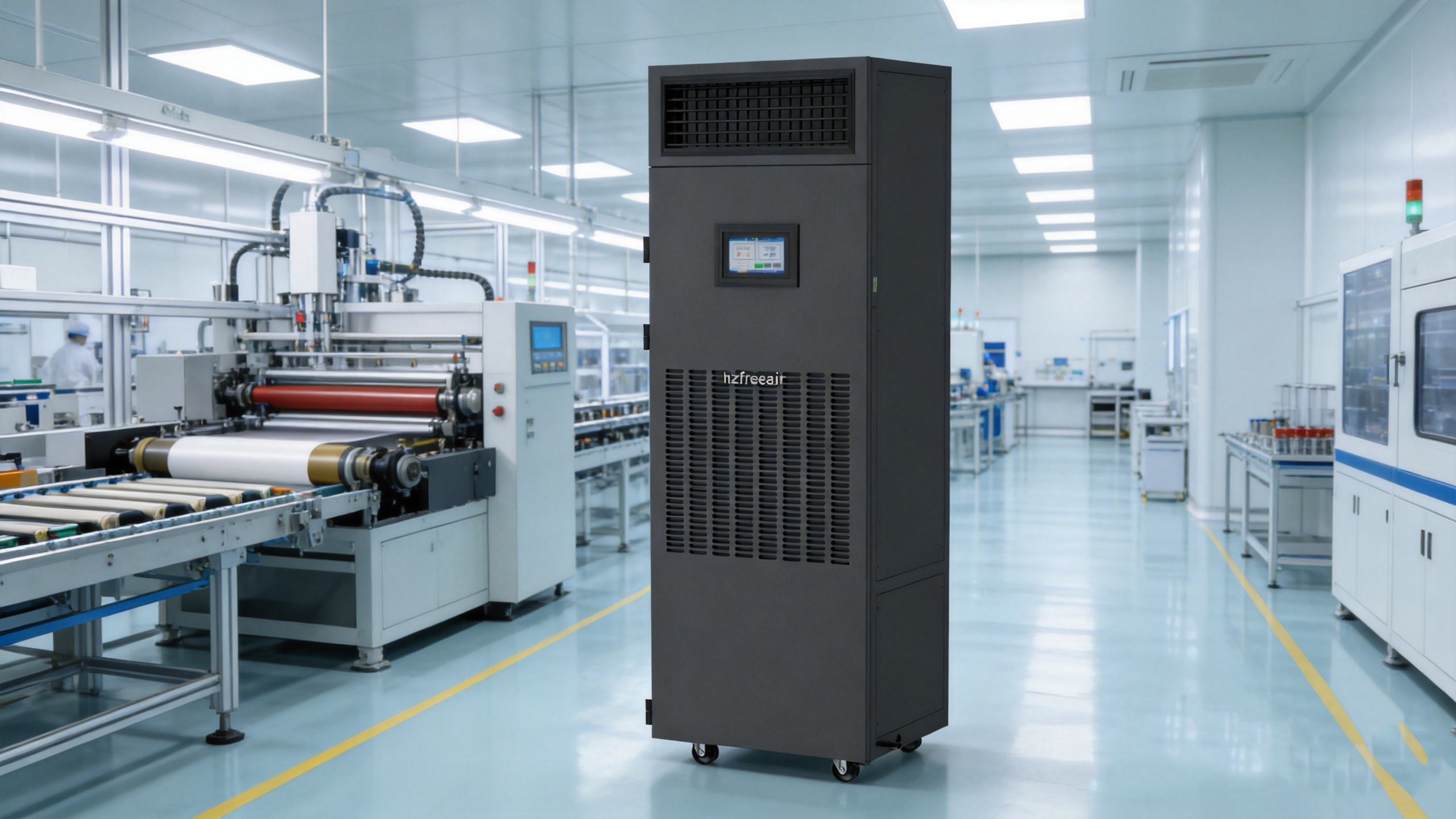
III. Technical Approach: Synergistic Operation of Humidifiers and Dehumidification Rotors
To achieve an ultra-low dew point environment of -40°C DP or lower, conventional refrigeration-based dehumidification is completely ineffective. The current mainstream technical solution involves a two-stage system combining a desiccant wheel dehumidification system with a constant humidity unit.
The desiccant wheel serves as the “vanguard.” Its core component is a rotating wheel loaded with a honeycomb-shaped moisture-absorbing medium (typically silica gel or molecular sieves). As treated air passes through the wheel’s moisture-absorption zone, moisture is adsorbed, achieving extremely low humidity levels; simultaneously, a separate stream of high-temperature regeneration air desorbs and expels the moisture from the wheel. This process reliably lowers the workshop dew point to below -40°C DP, meeting the core requirements for coating, winding, and liquid injection.
However, the issue with desiccant wheel dehumidification is that it can only “remove” moisture; it cannot “precisely control” it. If the actual humidity in the workshop falls below the process lower limit (e.g., localized dryness in certain areas after personnel movement), the desiccant wheel cannot reverse its operation to humidify. In such cases, the constant humidity unit acts as the “goalkeeper.”
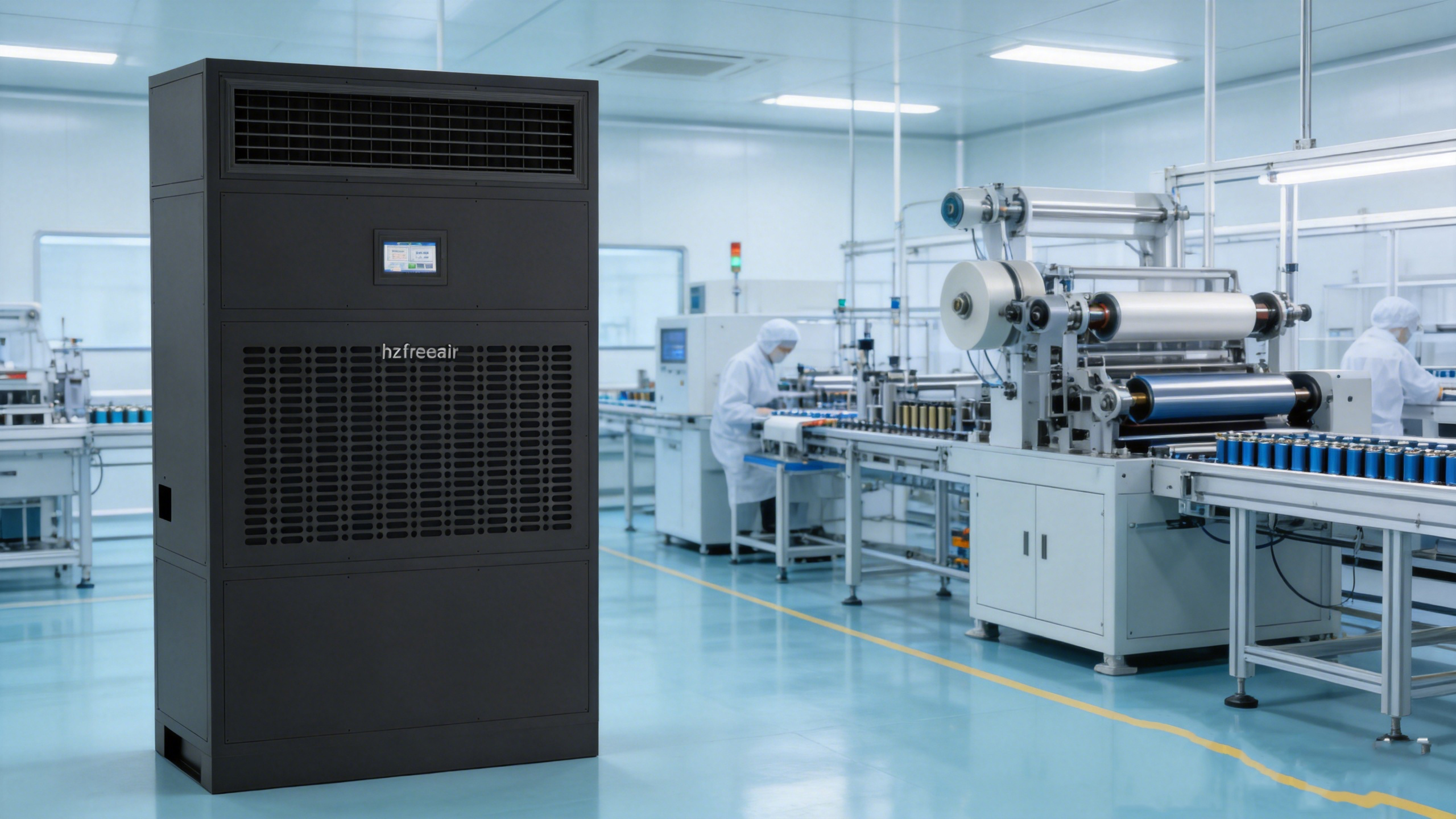
Humidity control units integrate humidification modules with fine-tuning dehumidification modules and are typically deployed downstream of desiccant wheel dehumidifiers or in buffer zones between different cleanliness levels. Using real-time feedback from high-precision dew point sensors (with an accuracy of ±0.2°C DP), they automatically determine whether to supplement the environment with trace amounts of pure steam (typically distilled water vapor to prevent introducing contaminants), thereby stabilizing the local relative humidity or dew point within set thresholds.
The division of labor between the two is clear:
The dehumidification wheel is responsible for the significant transition “from humid to extremely dry.”
The constant humidity unit handles “fine-tuning and correction,” preventing excessive drying or a rebound in humidity.
IV. Necessity: Multi-Level Humidity Gradient Control
A well-designed lithium-ion battery production facility typically incorporates three humidity gradients along the production line:
Ultra-low humidity zone (below a dew point of -40°C DP): Pre-processes including coating, calendering, slitting, winding, and pre-electrolyte filling. Utilizes desiccant dehumidifiers combined with cascade dryers.
Low-Humidity Zone (Dew Point -30°C DP to -20°C DP): Post-electrolyte filling processes such as curing and packaging. Here, the desiccant wheel continues to operate, but a constant-humidity unit is activated to prevent excessive drying.
Comfort Zone (Relative Humidity 30%–50%): Aging, capacity testing, assembly, and testing areas. Independent regulation via constant-humidity units prevents electrostatic hazards and ensures stable operating conditions for personnel.
Without the precise control provided by a constant humidity unit, two harmful scenarios may arise:
Upstream humidity fluctuations: Relying solely on the desiccant wheel may cause local dew points to drop below -60°C DP, which paradoxically increases electrode brittleness and causes coating cracks.
Downstream humidity runaway: If sealed batteries are stored long-term in an ultra-low humidity environment, the casing may deform slightly due to internal-external pressure differentials, and the risk of static electricity surges sharply.
The “strictly tiered, precisely regulated” humidity field created by the humidity control unit in conjunction with the dehumidification wheel is the core safeguard for lithium-ion batteries, from bare cells to safe encapsulation.
Conclusion
The “fear of dryness and humidity” in lithium-ion battery production workshops is not a play on words, but a real challenge regarding humidity control precision and consistency across zones. Constant humidity units are no longer merely “humidifiers” in the traditional sense, but rather intelligent nodes that form a closed-loop system with dehumidification rotors. As the new energy industry advances toward micron-level manufacturing and zero-defect delivery, the precise control of every gram of moisture is critical to battery lifespan and safety. Only by understanding the dialectical relationship between “dry and wet” can we truly master the essence of lithium-ion battery manufacturing.
 vivienhu0427@hotmail.com
 +86 15958041362
 vivien@hzfreeair.com