
In modern research laboratories, the precision of instruments and equipment continues to improve, with measurement capabilities approaching physical limits. However, the more precise the instrument, the more sensitive it is to changes in the external environment. Temperature fluctuations, humidity shifts, air turbulence, and micro-vibrations—these factors, imperceptible to the naked eye, are often the root cause of experimental data where “a slight error leads to a massive discrepancy.” Behind these precision instruments, a proven microenvironment control system acts as a “stabilizing force,” silently safeguarding the accuracy and reproducibility of every measurement.
Extreme Sensitivity to Temperature and Humidity: The “Achilles’ Heel” of Precision Instruments
Take precision balances as an example. The core function of such equipment is to measure minute differences in mass. When the ambient temperature fluctuates by more than ±0.5°C, the balance’s internal electromagnetic compensation system, elastic components, and circuit boards all experience zero-point drift due to thermal expansion and contraction. Even more insidious is the fact that temperature changes alter air density, thereby changing the buoyancy exerted on the sample—for microgram-level weighing, this is no longer a negligible systematic error.
Electron microscopes and spectrometers, meanwhile, have even stricter requirements regarding humidity. Experiments show that when relative humidity exceeds 40% RH, water films easily form on the surfaces of internal optical components, not only affecting light transmission efficiency but also accelerating the oxidation and corrosion of metal parts. More importantly, under the influence of high-voltage electric fields, water molecules adsorb charged particles in the air, forming leakage paths that lead to a decrease in image signal-to-noise ratio and baseline drift. Therefore, many precision analytical instruments explicitly require that ambient humidity be strictly controlled below 40% RH to reduce the risk of static electricity buildup and electrical leakage.
Ceiling-Mounted Constant Temperature and Humidity Units: Ensuring a “Gentle” Airflow
Traditional air conditioning systems typically use side or downward airflow, where air is blown directly onto the instrument area, easily causing local temperature fluctuations and air turbulence. More critically, mechanical vibrations generated by the air conditioning fan are transmitted through the floor and ductwork to the laboratory benches. For equipment like electron microscopes, which are extremely sensitive to even nanoscale vibrations, such interference is devastating.
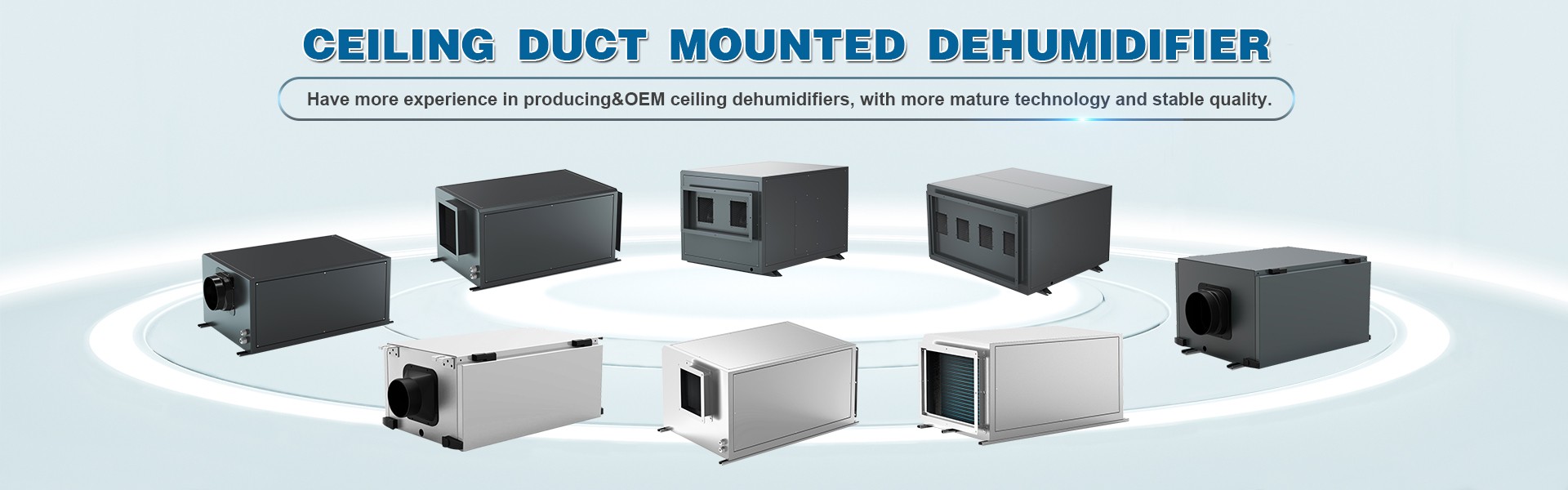
The ingenuity of ceiling-mounted air conditioning units lies in their “remote air delivery” design. By suspending the unit above the laboratory ceiling and utilizing an extended static pressure chamber and distributed micro-perforated air outlet panels, cool air descends uniformly over a wide area at an extremely low velocity. This “laminar flow” air distribution method not only avoids the localized temperature inconsistencies caused by direct airflow but, more importantly, employs flexible connections and multiple vibration-damping devices between the fan and the laboratory’s main structure. Vibrations are isolated within the ceiling cavity and do not transmit to the precision instrument area below. Practical engineering tests have shown that a properly designed ceiling-mounted unit layout can reduce vibration amplitude in the floor area by more than an order of magnitude.
Multi-stage Filtration: The Invisible “Pollutant Cleaners”
The hazards in laboratory air extend far beyond dust particles. In addition to conventional PM2.5 and PM10, precision instruments are particularly vulnerable to ionic pollutants—such as sulfate, nitrate, and chloride ions. Once these ionic aerosols settle on the surfaces of optical components or circuit boards, they form conductive bridges or corrosion spots, leading to baseline drift in spectrometers and abnormal contrast in electron microscope images.
For this reason, microenvironment control systems in high-end laboratories typically integrate a three-stage filtration system: the first stage consists of a pre-filter that intercepts large dust particles larger than 10 microns; the second stage uses a medium-efficiency filter to remove fine particles ranging from 1 to 10 microns; and the third stage combines a High-Efficiency Particulate Air (HEPA) filter with a chemical filter. HEPA filters achieve an efficiency of over 99.97% for particles as small as 0.3 microns, while the chemical filtration layer uses media such as activated carbon and impregnated alumina to adsorb acidic gases and ionic contaminants. The air supplied by this system achieves a cleanliness level of ISO Class 5 (Class 100) or higher, providing precision instruments with a near-zero-dust, zero-ion environment.
Data Reproducibility: The Ultimate Value of Microenvironment Control
The essence of scientific research lies in verifiability and reproducibility. A precision balance operating in an uncontrolled microenvironment may yield different weighing results in the morning and afternoon; a spectrometer without stable temperature and humidity control may experience baseline fluctuations that drift up and down with the cycling of the air conditioning. These seemingly minor deviations, when accumulated, are sufficient to undermine the credibility of a study’s data.
This is precisely the significance of the “Anchor of Stability”—it is not the star of the experiment, yet it is the prerequisite for all precise measurements. From the remote airflow and vibration-damping design of the ceiling-mounted unit to the multi-stage filtration system that intercepts dust and ionic pollutants layer by layer, every technical detail serves a single goal: to enable the instrument to perform at its designed limits within a stable microenvironment, ensuring that every measurement starts from the same baseline. In this sense, the laboratory’s microenvironment control system is not only the guardian of the equipment but also the guardian of scientific truth.
 vivienhu0427@hotmail.com
 +86 15958041362
 vivien@hzfreeair.com