
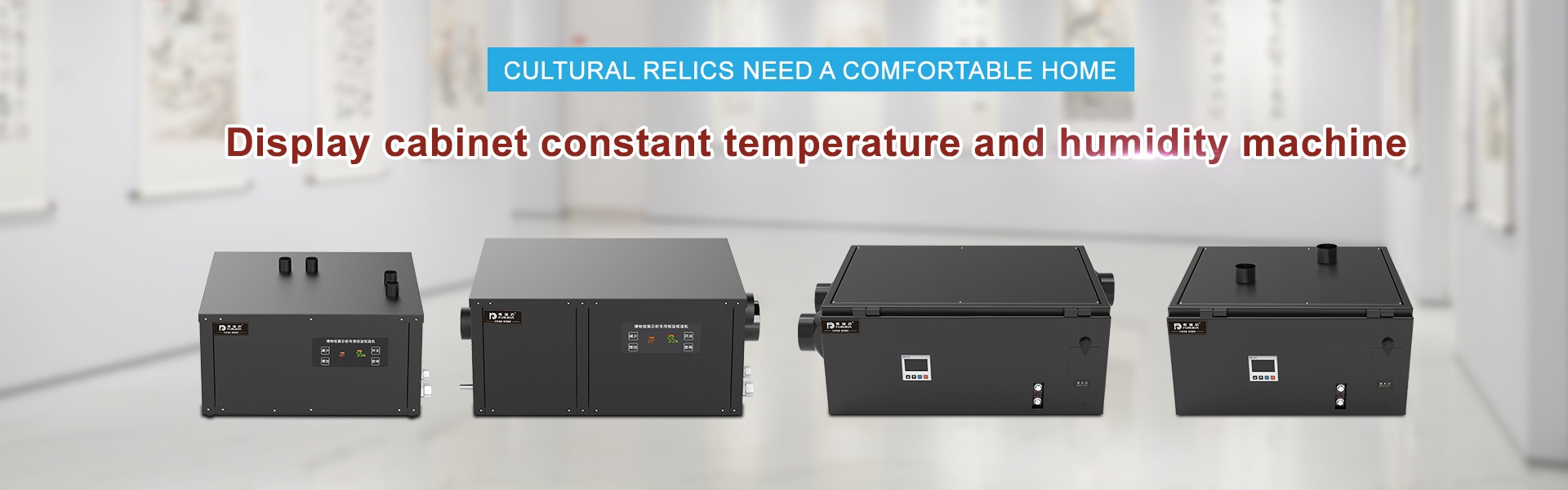

Constant temperature and humidity control systems represent a core technology in modern industrial manufacturing, precision
experimentation, data centers, and cultural heritage preservation. On the surface, the system must simultaneously maintain two
independent parameters—temperature and humidity—within specified ranges. However, delving into its thermodynamic and
air-handling principles reveals complex interactions between these two variables. These interactions make the design and
implementation of constant temperature and humidity systems highly challenging, often requiring a deep understanding of
coupling effects and the application of precise decoupling control strategies.
Physical Foundations and Distinct Characteristics of Temperature and Humidity Control
Temperature control is fundamentally a thermodynamic process governed by the law of conservation of energy (the first law
of thermodynamics). Systems regulate temperature by altering the internal energy of air through heating or cooling. Temperature
changes respond relatively quickly, and control mechanisms are relatively straightforward; common devices like chilled water
coils and electric heaters enable highly efficient regulation.
Humidity control, however, is a mass transfer process involving the increase or decrease of water vapor content in air.
Humidification is typically achieved by introducing water vapor into the air (e.g., steam humidification, ultrasonic humidification),
while dehumidification primarily occurs by cooling air below its dew point to condense moisture or using hygroscopic materials
to adsorb water. This process often involves significant heat exchange. For instance, cooling dehumidification removes moisture
while simultaneously dissipating substantial sensible heat, leading to temperature reduction; conversely, steam humidification
increases humidity by transferring latent heat to the air, potentially causing temperature elevation.
Coupling and Interference: The Core of Control Challenges
The fundamental difficulty in constant temperature and humidity systems lies in the strong coupling between temperature and
humidity within these physical processes. Virtually any manipulation of one parameter inevitably induces significant interference
in the other:
Temperature Interference During Dehumidification: The most common scenario arises when dehumidification is required. Using
cooling coils to lower air temperature below the dew point for condensation-based dehumidification is an efficient method.
However, this process simultaneously reduces the air's sensible heat content substantially. Without compensatory heating, the
ambient temperature will drop significantly below the setpoint. This implies that a simple dehumidification command can trigger
a “temperature defense battle” requiring intervention from the temperature control system.
Temperature interference during humidification: When using isothermal humidification (such as dry steam humidification), the
introduced steam carries latent heat into the air. While increasing humidity, this causes a slight rise in the air's dry-bulb temperature.
Although this temperature rise is smaller than the temperature drop caused by cooling dehumidification, it still requires consideration
and compensation in high-precision control scenarios.
Indirect Effects of Temperature Regulation on Humidity: When cooling is used to lower temperature, if the coil surface temperature
falls below the air dew point, unintended dehumidification occurs, causing humidity to decrease. Conversely, heating the air reduces
its relative humidity (as the air's capacity to hold water vapor increases with temperature). . Thus, an action seemingly aimed solely at
adjusting temperature may inadvertently disrupt humidity stability.
This “domino effect” coupling renders traditional methods of controlling temperature and humidity as two independent single-loop
systems ineffective. The control output of one loop becomes a disturbance to the other, causing the system to oscillate continuously
and making it difficult to achieve both high precision and stable conditions simultaneously.
The Path to Decoupling: Advanced Control Strategies
To overcome coupling challenges and achieve independent, precise temperature and humidity control, advanced constant temperature
and humidity systems employ multiple decoupling control strategies:
Physical Decoupling in Air Handling Processes: This fundamental approach involves designing air treatment flows where temperature and
humidity adjustments occur in independent or sequential stages. A classic approach is “Cooling Dehumidification + Reheat”: First, air
is cooled and dehumidified via a cooling coil (which may involve overcooling). Then, a reheater (e.g., electric heater or hot water coil)
precisely reheats the air to the supply air temperature setpoint. This separates humidity control—achieved by adjusting cooling coil depth
(or using bypass)—from temperature control—managed by regulating reheat capacity. However, this approach typically incurs higher
energy consumption.
Decoupling at the Control Algorithm Level:
Feedforward Compensation: The control system continuously monitors operating variables that may cause coupling disturbances.
For example, when the dehumidification cooling coil activates, the temperature control loop anticipates the resulting temperature
drop and immediately calculates the required heating compensation. It proactively applies reheat rather than reacting after a
temperature deviation occurs, significantly mitigating coupling disturbances.
Multivariable Decoupling Control: Model the temperature-humidity control system as a coupled system with multiple inputs
(e.g., cooling load, heating load, humidification rate) and multiple outputs (temperature, humidity). By designing decoupling
compensators, virtual “independent channels” are algorithmically constructed. This ensures that control commands targeting
temperature primarily affect temperature, while commands targeting humidity primarily affect humidity. Tools from modern control
theory, such as state feedback and decoupling networks, support this approach.
Model Predictive Control: This represents a more advanced approach. The controller incorporates a predictive model that describes
the dynamic characteristics and coupling relationships of temperature and humidity. During each control cycle, it not only responds
to the current error but also uses the model to predict the trajectory of temperature and humidity changes under various control
combinations over a future period. This enables the optimization of a series of control actions, achieving global optimization control
that satisfies temperature and humidity accuracy while potentially balancing economic indicators such as energy consumption.
Conclusion
Returning to the question “Which is harder to control: temperature or humidity?”, the answer becomes clearer upon deeper analysis:
humidity control typically presents greater challenges, while the highest difficulty lies in mastering the coupling relationship between the two.
Humidity control inherently exhibits stronger nonlinearity and hysteresis, and is highly susceptible to passive influences from temperature
changes. However, the true essence of a constant temperature and humidity system lies not in taming these “two beasts”—temperature
and humidity—individually, but in deeply understanding the invisible “chain” linking them: the thermohygric coupling effect. By employing
sophisticated physical design or intelligent control algorithms, this chain can be broken or harnessed to our advantage.
Thus, an exceptional constant temperature and humidity system represents the culmination of thermodynamic principles, air-handling processes,
and automated control intelligence. It does not pursue absolute temperature stagnation or immutable humidity, but rather weaves a precise,
coordinated, and resilient web of parameters for spaces requiring highly stable environments within the dynamic physical world. This balancing
act is the eternal driving force behind continuous exploration and innovation in environmental control.
 vivienhu0427@hotmail.com
 +86 15958041362
 vivien@hzfreeair.com