
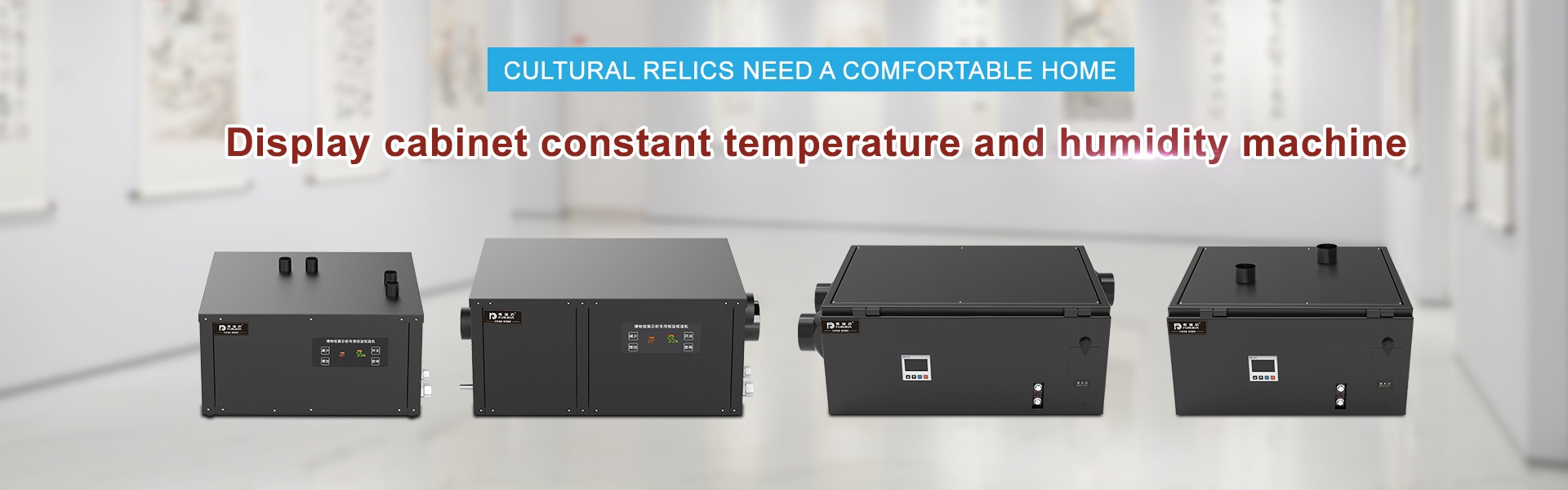

In many environments with extremely stringent air quality requirements—such as precision manufacturing workshops, museums,
laboratories, or data centers—constant temperature and humidity systems are central to maintaining environmental stability.
As two fundamental environmental parameters, temperature and humidity appear independently controllable, yet they are
profoundly interconnected and coupled. In the pursuit of independent, precise control, engineers confront a series of challenges
rooted in thermodynamic principles and control engineering.
Thermodynamic Coupling: Two Sides of the Same Coin
To grasp these control challenges, one must first examine the thermodynamic properties of air. Temperature and humidity are
not independent variables; they are intrinsically linked through air's enthalpy and moisture content.
The essence of humidity control lies in regulating the partial pressure of water vapor, while temperature directly influences the
air's saturated vapor pressure (i.e., its capacity to hold moisture). Attempting to alter one parameter often “unintentionally”
disturbs the other. A classic example is the cooling-based dehumidification process: as air passes through cooling coils and its
temperature drops below the dew point, moisture condenses and separates, achieving dehumidification. However, this simultaneously
causes a significant decrease in air temperature. If the objective is solely dehumidification without cooling, the system must
subsequently reheat the air, resulting in dual energy consumption and process complexity.
Conversely, a simple heating process increases air temperature without adding moisture, thereby reducing relative humidity
(as the air's saturated vapor pressure rises). This inherent physical coupling means any unilateral adjustment action may cause
deviation in the other parameter.
Interference and Decoupling Challenges in Control Systems
Within control systems, this physical coupling manifests as significant mutual interference. A simple single-loop control
strategy (e.g., using only a thermostat to control the heater and only a humidistat to control the humidifier) often leads to
oscillatory instability during actual operation. For example, when low humidity requires humidification, the evaporation or
atomization process absorbs latent heat, lowering air temperature. The temperature control system detects this drop and
activates heating, which in turn reduces relative humidity—potentially triggering another humidification demand... This
creates a positive feedback loop, preventing system stabilization.
Therefore, one core design objective of advanced constant temperature and humidity systems is to decouple temperature
and humidity control. Decoupling does not mean physically separating the two (which is impossible), but rather, through
control algorithms and system design, predicting and compensating for the influence of one on the other, enabling both
control loops to operate stably as independent systems.
Advanced Control Strategies: From Prediction to Intelligent Compensation
Modern constant temperature and humidity systems employ multiple advanced strategies to address this challenge:
Feedforward-Feedback Composite Control: This serves as the foundational decoupling strategy. The system not only
adjusts based on current deviations in temperature/humidity (feedback) but also continuously monitors potential
disturbance sources (e.g., fresh air temperature/humidity, indoor load changes). It pre-calculates their impact on the
other parameter and issues compensatory commands in advance (feedforward). For example, upon detecting a large
influx of low-temperature fresh air, the system calculates the required heating while simultaneously estimating its
humidity-reducing effect, then preemptively fine-tunes the humidification output.
Cross-Decoupling Control Algorithm: Establishes a mathematical model (transfer function) within the controller that
describes the mutual influence between temperature and humidity. When the temperature controller outputs a
regulation signal, it simultaneously sends a “decoupling signal” to the humidity controller, informing it: “Temperature
will change by X degrees, which is expected to cause a Y change in humidity. Please preemptively adjust Y' to counteract it.”
The humidity controller's influence on temperature follows the same principle. This achieves logical independence between
the two loops.
Model Predictive Control: This represents a more advanced strategy. The control system employs a dynamic model to
perform rolling optimization calculations on the projected trends of temperature and humidity over a future timeframe.
It not only considers the current state but also anticipates future disturbances, deriving a series of optimal control actions
(such as adjusting the opening of chilled water valves, heaters, humidifiers, and reheat valves). This enables temperature
and humidity to reach their setpoints in a coordinated, smooth, and efficient manner, avoiding mutual interference.
Conclusion: Comprehensive Considerations in Dynamic Environments
Returning to the original question: Which is harder to control—temperature or humidity? The answer isn't fixed. In scenarios
with minimal disturbances and broad setpoint ranges, temperature control is typically easier due to its direct response and
high sensor accuracy. However, in high-precision, stringent environments with frequent disturbances, humidity control often
proves more challenging.
This stems from water's substantial latent heat of phase change. Humidity sensors—particularly relative humidity sensors—
typically lag behind temperature sensors in response speed, long-term stability, and contamination resistance. More critically,
humidity is more susceptible to diverse disturbances (occupant movement, door openings, process-generated moisture, etc.),
and its regulation processes (dehumidification/humidification) almost invariably involve significant thermal effects that exert
substantial impact on the temperature loop. Consequently, in many high-end applications, the stability of the humidity loop
often becomes the bottleneck and critical factor for the entire system's stability.
In essence, the artistry of constant temperature and humidity systems lies not in treating temperature and humidity as two
separate enemies to conquer, but in profoundly understanding their dance-like coupling relationship. By applying wisdom
and advanced technology, we guide these “dancing partners” to move in harmony, ultimately creating a stable and precise
environment within a dynamically changing world. This represents not only a triumph of control engineering but also a testament
to humanity's deep comprehension and ingenious application of physical laws.
 vivienhu0427@hotmail.com
 +86 15958041362
 vivien@hzfreeair.com