In a corner of the living room, a beautifully designed dehumidifier is quietly operating. The light beige body blends seamlessly
with the wall, and without the flickering numbers on the display, it is hardly noticeable.
In modern home design concepts, quietness and aesthetics have become important indicators of living quality. As a "invisible
guardian" of modern homes, household dehumidifiers are undergoing a transformation from functional appliances to aesthetic
elements of the home.
01 Evolutionary Path
In the past, dehumidifiers were often a "function-first" bulky object in home design, with a cumbersome shape and significant
noise. They were often placed in corners of the room or hidden in inconspicuous places, incompatible with the interior design
style. They seemed to be merely tools for solving humidity problems, lacking a harmonious dialogue with the living environment.
With the evolution of home design concepts, today's dehumidifiers no longer satisfy with a single humidity regulation function.
They have begun to innovate in appearance and noise reduction. This transformation reflects the transition from a function-
oriented design to an experience-oriented design.
More and more families have realized that "invisible appliances" like dehumidifiers should become part of the overall interior
design, rather than existing as an isolated and conspicuous presence.
02 Evolution of Appearance
Appearance customization has become a key approach for modern dehumidifiers to integrate into home design. The appearance
of dehumidifiers is no longer limited to industrial design thinking, but begins to consider harmonious coexistence with various
home styles.
The soft and rounded R-corner design gradually replaces the traditional straight edges, making the machine more smooth and
natural. This design not only increases the tactile comfort but also enhances the visual harmony.
In terms of color, dehumidifiers begin to offer a variety of color options, from classic pure white to warm tones suitable for
wooden styles, to neutral color schemes of modern styles, providing users with more matching possibilities.
Some products even offer replaceable panels or handles, allowing users to make personalized changes according to the season,
mood, or home style. Material selection expands from simple engineering plastics to frosted surfaces, metallic textures, and
other options, enhancing product quality and increasing the coordination with different home materials.
03 Silent Revolution
Silent technology is another key element for dehumidifiers to integrate into the home environment. Data shows that advanced
dehumidifiers can operate with noise as low as 42.4 decibels, even lower. This figure is only slightly higher than the background
noise of a library, and will not cause interference to family life.
To achieve this silent effect, manufacturers have adopted various noise reduction technologies. Vibration damping structure is
one of the core technologies, through scientific mechanical structure design, reducing the vibration of the compressor from
being transferred to the casing.
Efficient sound insulation wrapping materials are also widely used, which can absorb and block the noise generated inside
the equipment.
The combination of a compact design and high-quality components, along with scientific air flow design, creates an ultimate
quiet noise control effect.
Some models even come with a dedicated sleep mode, in which the compressor does not operate or runs at a low speed,
reducing the noise to around 23 decibels, almost equivalent to the background noise of a quiet night.
04 Embedded Art
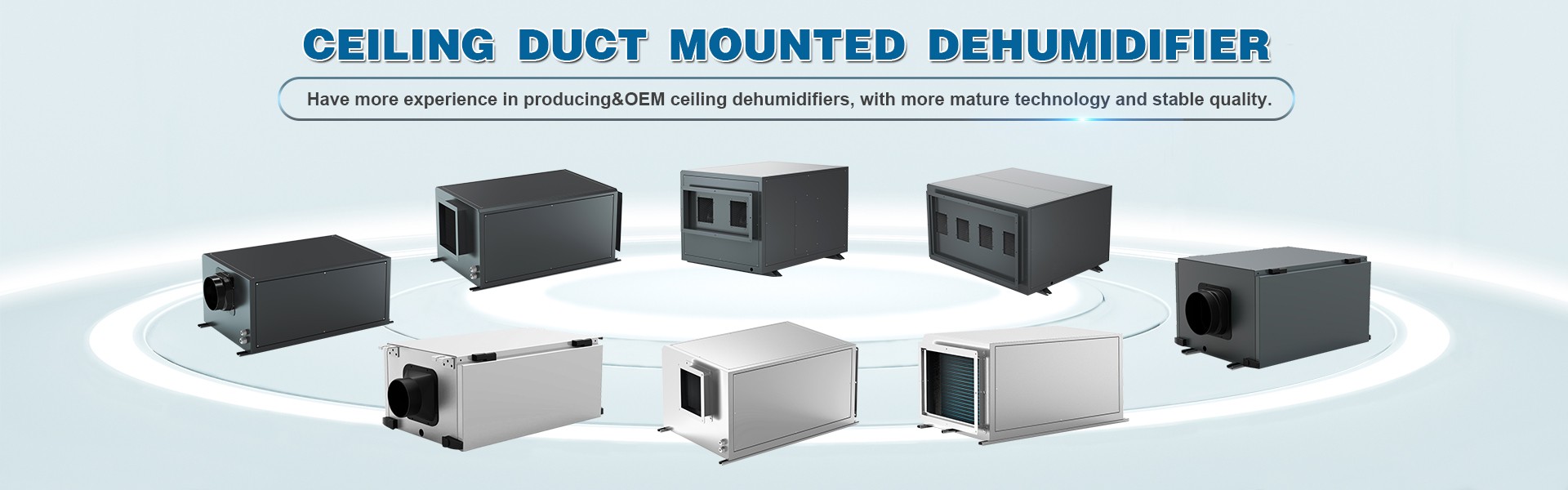
For families seeking the ultimate aesthetic of space, embedded installation is the ideal choice. Embedded dehumidifiers can
fully integrate into the overall decoration design, such as being hidden inside walls or ceilings, interacting with the space
only through carefully designed outlets and return vents.
The innovative top-outlet and side-inlet design allows dehumidifiers to be placed closely against the wall, no longer requiring
a large area for installation. This design, through the structure of top-outlet and side-inlet, maintains efficiency while
significantly reducing the equipment's occupation of space, improving usability, and making the product appearance
more beautiful.
Hanging dehumidifiers combined with hidden air conditioning systems, along with minimalist linear outlets, can seamlessly
integrate into the overall ceiling design. This "disappearing design" ensures that dehumidifiers no longer occupy floor space
while maintaining air circulation efficiency, achieving a perfect combination of aesthetic and functionality.
05 Design Matching
To make dehumidifiers seamlessly integrate into interior design, choosing the right style matching is crucial. Here I summarize
several suggestions for matching mainstream home styles with dehumidifier design elements:
| Home style | Recommended design elements | Integration method |
| Modern minimalist style | Solid color matte surface, simple geometric shape, concealed display screen | Choose neutral tones that blend with the background wall color and place them in the corner |
| New Chinese style / Japanese log style | Soft R-corner design, light white/soft gray color scheme, wooden texture elements | Combine natural materials, such as bamboo decorations or stone backgrounds, to create a natural atmosphere |
| Industrial style | Metallic texture surface, exposed structural elements, dark color scheme | Place them next to metal furniture or along concrete walls to complement the industrial elements |
| Nordic style | Pure white or light tones, rounded lines, minimalist operation interface | Pair with light-colored wooden furniture and use storage boxes to hide cables, maintaining a simple look |
06 Trends and Future
Home design is moving towards the direction of "invisibility and intelligence", and dehumidifiers are no exception. The integration
of appearance and function will be the future trend - powerful dehumidifiers no longer need to sacrifice a large size, and structural
improvements have made the layout of functional components more compact and efficient.
With the popularization of smart home systems, dehumidifiers will form a linkage with other home devices to achieve automated
humidity management.
Integrated machine design combines multiple functions such as dehumidification, purification, and air circulation, reducing the
number of devices in the home and simplifying the spatial layout. The combination of healthy materials and dehumidification
technology has also become a trend, for example, the porous structure of siliceous inorganic dry powder wall material can assist
in regulating indoor humidity, working together with the dehumidifier to create a comfortable environment.
The first rays of morning sunlight shine through the floor-to-ceiling window, reflecting on a simple-designed dehumidifier in the
living room. Its body almost blends with the wall, and the gentle lines of the shape resemble a carefully designed home decoration.
When the rainy season arrives, this machine operates quietly, keeping the indoor humidity at a comfortable range of 40%-60%,
and the walls no longer have mold spots, and the clothes in the wardrobe remain dry to the touch.
 vivienhu0427@hotmail.com
 +86 15958041362
 vivien@hzfreeair.com