
In textile production processes such as cotton and wool spinning, controlling workshop humidity has always been a key factor affecting product quality and production efficiency. However, many textile enterprises often fail to give sufficient attention to humidity management in actual production, or rely on traditional control methods with obvious shortcomings. This leads to persistently high yarn break rates, frequent lint issues, and even compromises the hand feel and quality of the final fabric.
Production Challenges Caused by Humidity Imbalance
Textile fibers possess natural moisture-absorbing and moisture-releasing properties and are extremely sensitive to ambient humidity. When the relative humidity in the workshop is too low, moisture is lost from the fibers, causing them to become dry, brittle, and hard, with a significant decrease in strength. During the spinning process, fibers are highly prone to breakage, causing frequent yarn breaks. This not only reduces production efficiency but also increases the time required for splicing and leads to raw material waste. At the same time, a dry environment exacerbates static electricity, causing short fibers to scatter and form “lint”—which not only pollutes the workshop air but also entangles machinery and clogs filters, further deteriorating production conditions.
Conversely, when humidity is too high, fibers absorb water and swell, increasing their surface friction coefficient. This leads to issues such as fiber wrapping around rollers and sticking to bobbins, which similarly disrupt normal operations and may cause quality defects such as uneven yarn evenness and increased fuzziness.
Whether the environment is too dry or too humid, the result is ultimately reflected in the fabric as a rough hand feel, dull luster, and poor softness, directly affecting the product’s market value.
The Advantages of Precise Humidity Control
To achieve an ideal spinning environment, the key lies in maintaining the workshop’s relative humidity within the “golden range” of 65%–75% RH. Within this humidity range, fibers maintain an appropriate moisture content, achieving an optimal balance between flexibility and tensile strength—preventing brittle breakage due to dryness and avoiding fiber adhesion and winding around rollers due to excessive moisture. Under these conditions, yarn runs smoothly, yarn breaks decrease significantly, and fly lint is effectively suppressed, leading to simultaneous improvements in production efficiency and product quality.
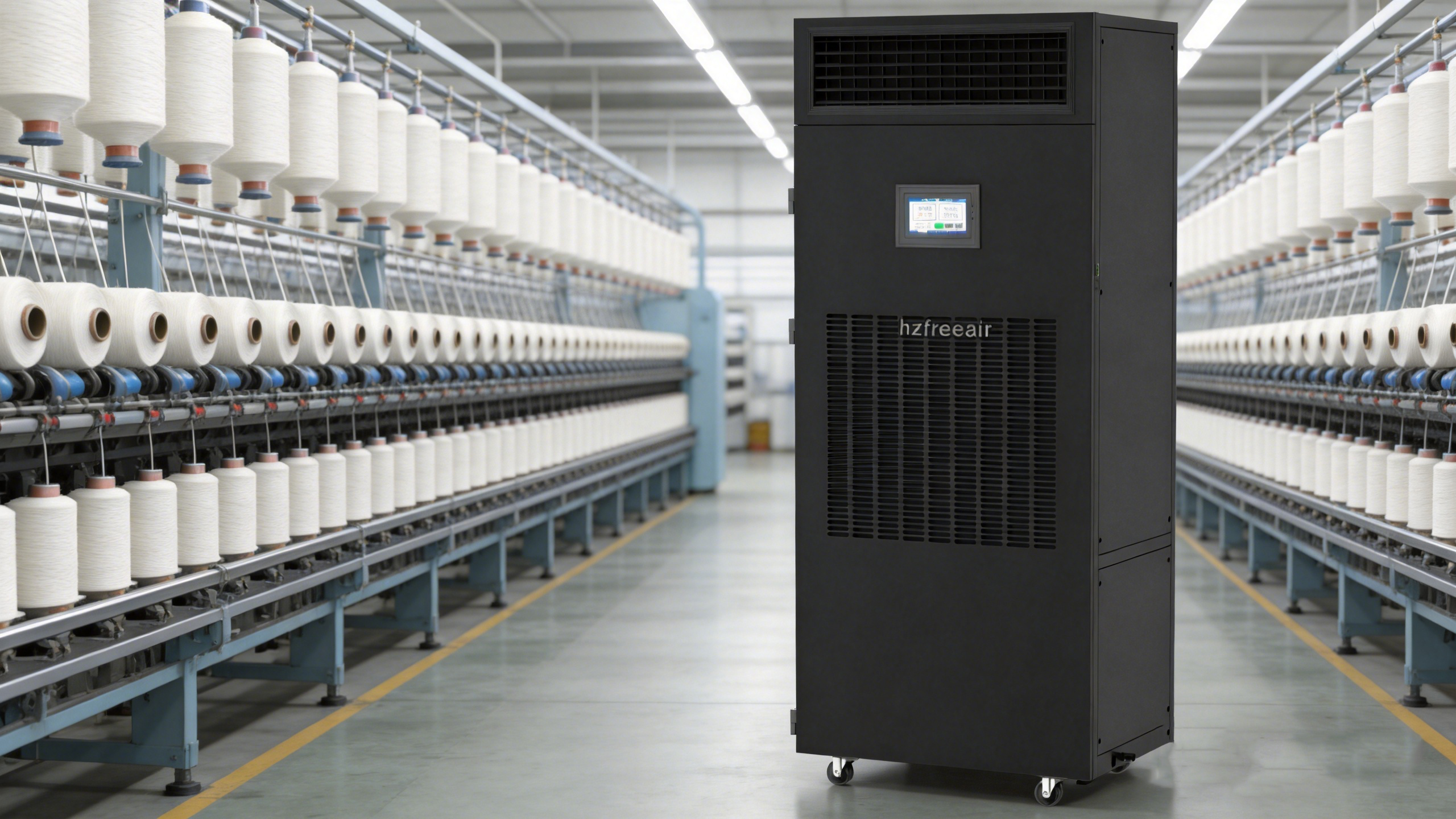
Humidifiers are the most efficient means of achieving this goal. Compared to traditional air conditioning spray systems, humidifiers utilize more advanced technologies such as wet-film humidification, high-pressure micro-mist, or electrode humidification. They can automatically adjust humidification levels based on real-time humidity signals in the workshop, achieving precise and stable humidity control while avoiding significant fluctuations. More importantly, constant humidity machines offer distinct advantages in terms of energy consumption.
Traditional air conditioning spray systems rely on refrigeration, heating, and extensive water pump circulation. To achieve humidification, they often require simultaneous temperature adjustments, resulting in massive power consumption. Particularly in textile workshops requiring prolonged, high-precision humidification, the electricity costs for operating such systems remain persistently high year-round, becoming a heavy burden for enterprises. In contrast, the humidification process of constant humidity machines does not rely on significant cooling or heating. Energy consumption is typically only a fraction of that of spray systems—or even lower—resulting in substantial long-term savings on electricity costs for enterprises.
Comprehensive Benefits and Implementation Recommendations
By optimizing workshop humidity to 65%–75% RH and adopting constant humidity machines as the core control equipment, enterprises can achieve multiple benefits:
Quality Improvement: Reduced yarn breaks and lint, significantly improved yarn uniformity and fabric hand feel, and enhanced product quality.
Efficiency Improvement: Reduced downtime caused by yarn breaks and yarn wrapping around rollers, leading to increased equipment uptime and output.
Cost Savings: Reduced raw material waste and scrap rates, while significantly cutting the high electricity costs associated with air conditioning and spray systems.
Environmental Improvement: Reduced lint in the workshop and improved air quality benefit employee health and equipment maintenance.
It is recommended that textile enterprises, when implementing humidity optimization, first conduct a survey and assessment of the temperature and humidity distribution in existing workshops, reasonably select the number and placement of constant humidity units, and establish an automatic interlocking control mechanism. At the same time, outdated air conditioning spray systems should be retrofitted or shut down to avoid the inefficient concurrent operation of two systems.
In summary, precisely controlling workshop humidity within the 65%–75% RH range and replacing energy-intensive traditional spray humidification with constant humidity units is not only an effective technical approach to reducing yarn breaks and improving fabric hand feel, but also a practical choice for enterprises to lower operating costs and enhance product competitiveness. In an era of slim profit margins within the industry, this seemingly minor environmental optimization may well become the key factor in distinguishing quality from cost.
 vivienhu0427@hotmail.com
 +86 15958041362
 vivien@hzfreeair.com