
In the quiet storage rooms and bright exhibition halls of museums, countless precious cultural relics are engaged in a silent “breathing” process—constantly exchanging moisture with their surroundings. For organic artifacts such as paper documents, lacquerware, and murals, the rhythm and extent of this “breathing” directly determine whether they can retain their original appearance across millennia. Humidity is the key variable that regulates this process.
Humidity Fluctuations: The Invisible Killer of Organic Artifacts
Organic artifacts are naturally sensitive to changes in humidity. Paper artifacts are composed of plant fibers, and the hydroxyl groups in cellulose readily bind with water molecules. When environmental humidity rises, the fibers absorb water and expand; when humidity drops, they lose water and contract. As this repeated deformation accumulates to a certain extent, it generates irreversible stress within the paper, ultimately manifesting as curling, warping, or even cracking along creases. Ancient calligraphy, paintings, sutra scrolls, and archival documents often gradually deteriorate to a point of no return amidst seemingly mild seasonal humidity fluctuations.
The challenges faced by lacquerware on a wooden base are even more complex. Wood is inherently anisotropic—expansion and contraction along the grain are far less than across it. Periodic fluctuations in humidity cause the wooden base to deform differentially in various directions, subjecting the interface between the lacquer layer and the base to continuous shear stress. When accumulated stress exceeds the elastic limit of the lacquer film, it triggers cracking and flaking. More insidiously, moisture migrates much more slowly within the wood than at the surface. This disparity in response rates between the interior and exterior generates significant internal stress within the wood structure, serving as a deep-seated cause of cracking and deformation.
Murals, meanwhile, are classic layered composites—the support, ground layer, and pigment layer each possess distinct water absorption rates and coefficients of thermal expansion. Fluctuations in humidity cause repeated relative displacement between these layers. Over time, this leads to a succession of pathologies, such as peeling of the pigment layer, blistering of the ground layer, and the propagation of cracks. What makes this particularly tragic is that damage to murals is often irreversible; once the pigment layer lifts and detaches from the ground, the brushstrokes of that era are lost forever.
Although these three types of cultural relics are made of vastly different materials, the mechanisms behind their deterioration are strikingly similar: fluctuations in humidity cause the materials to repeatedly absorb and lose moisture, with microscopic deformations accumulating into macroscopic cracking and peeling. The issue is not whether humidity is high or low, but whether it is stable.
Constant Humidity Units: Controlling “Breathing” to an Accuracy of ±3%
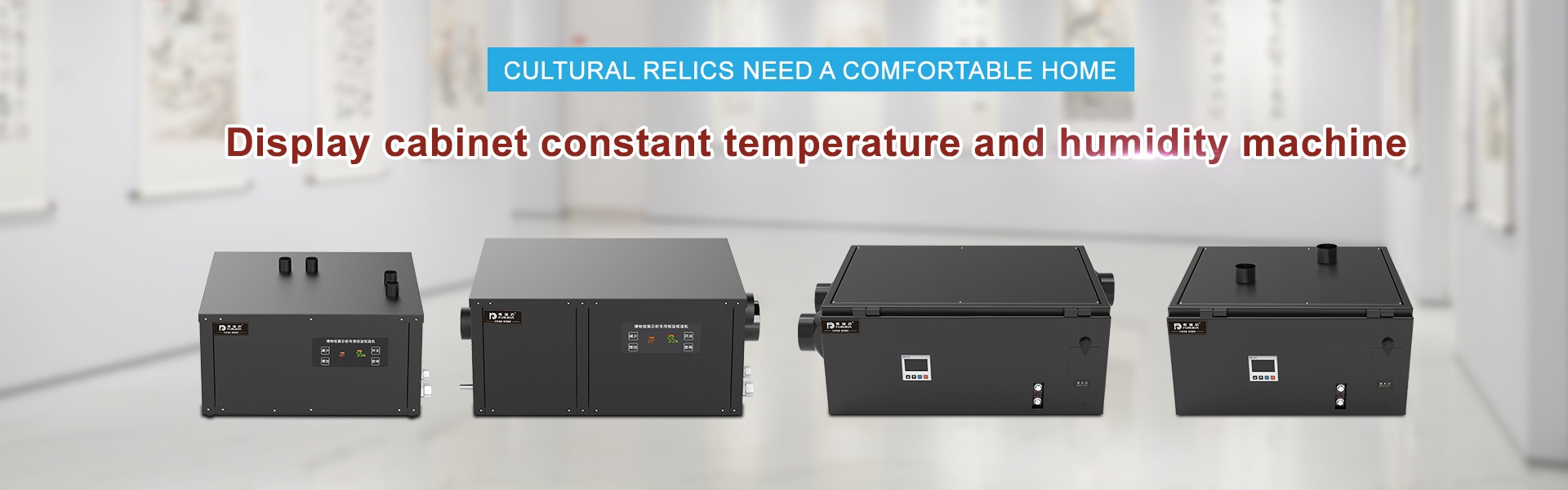
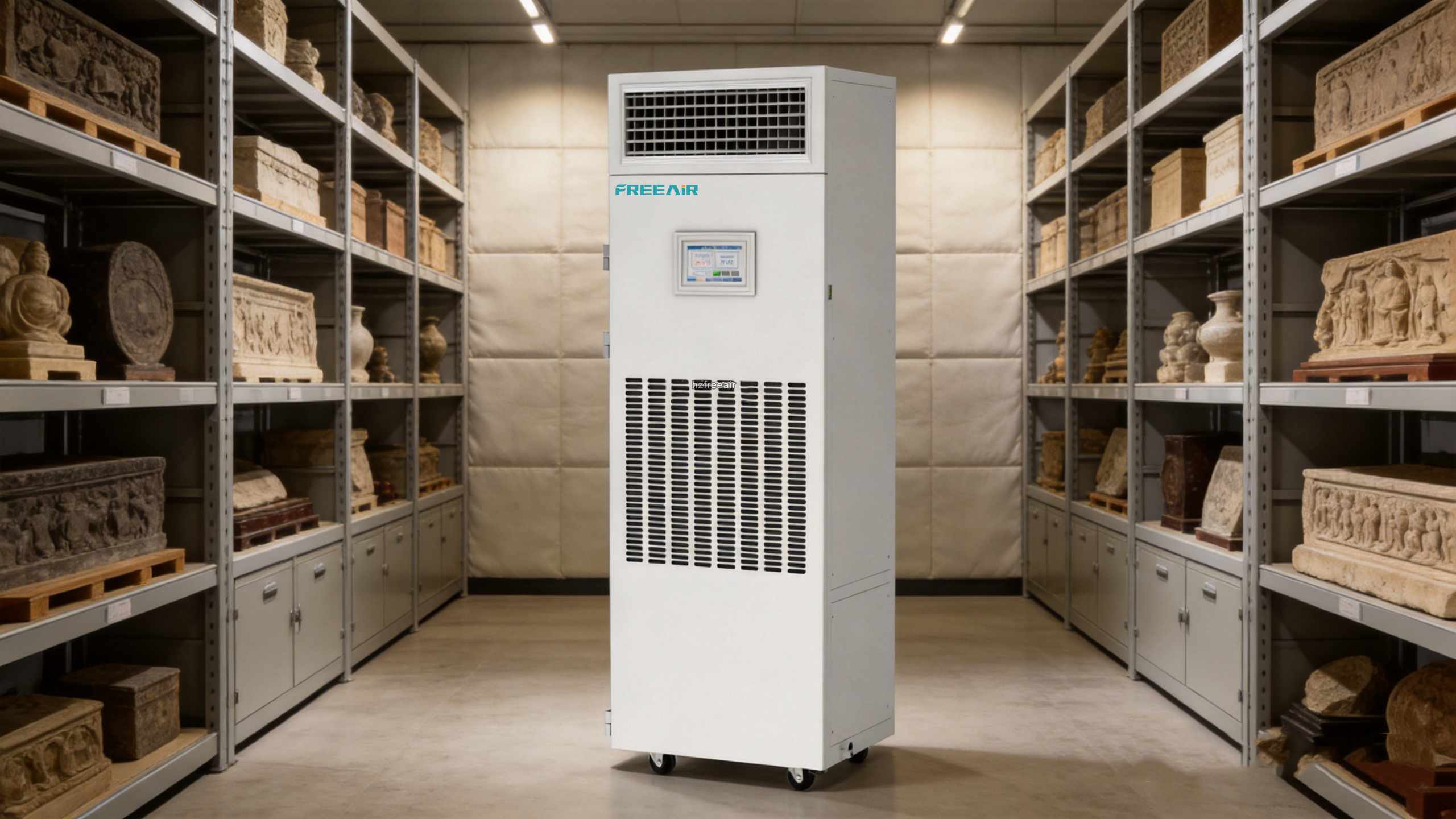
To address this critical issue, constant humidity units serve as “respiratory regulators” for cultural relics. Unlike the on-off control of traditional humidifiers or dehumidifiers, constant humidity units employ continuous regulation technology, capable of stabilizing the ambient relative humidity within an extremely narrow range around the set value—±3% RH has become the industry-standard benchmark for high-precision control.
Achieving this precision relies on three key technological components: First, real-time monitoring by high-sensitivity sensors, capable of capturing minute fluctuations in humidity at the millisecond level; second, intelligent control algorithms that dynamically calculate the intensity of humidification or dehumidification based on the deviation between current and target humidity levels, the rate of change in that deviation, and historical trends—rather than simply “turning on when limits are exceeded and off when targets are met”; Finally, the actuators—inverter compressors or solid-state humidification modules—precisely deliver the required amount of moisture transfer, preventing overshoot or undershoot. The synergy of these three elements results in a humidity curve within storage facilities or exhibition halls that is nearly a smooth straight line, eliminating the impact of sudden humidity fluctuations on cultural artifacts.
Solution: Tiered Control and Intelligent Coordination
In response to these challenges, industry practices have gradually developed effective solutions.
A tiered control architecture serves as the foundation. Humidity control is divided into three tiers: The first tier involves coarse regulation of the building’s overall environment, using measures such as retrofitting building envelopes and pre-treating fresh air to mitigate the direct impact of external weather on the museum interior; The second tier involves base regulation of large spaces such as storage areas or exhibition halls, where a centralized air conditioning system maintains humidity within a relatively broad yet safe range (e.g., 45%–65% RH); The third tier involves fine-tuning of the microenvironment within display cases, where a humidity-control system inside the sealed display case precisely stabilizes humidity at the optimal level for the specific material of the artifacts. Each of these three tiers has distinct functions and operates independently without interfering with one another.
The core lies in intelligent interconnection strategies. Communication protocols are established between the humidity control equipment inside the display cases and the central air conditioning system in the storage area to enable data sharing. When a significant change in humidity is detected in the large space (such as when air conditioning settings are adjusted due to seasonal changes), the system sends an early warning to the display case humidity control equipment, allowing it to enter a standby state or proactively adjust its internal humidity settings to ensure a smooth transition rather than passive resistance. Simultaneously, a “buffer layer” is established between the display case and the larger space—for example, by incorporating replaceable humidity control modules into the display case’s back panel, which utilize the properties of physically adsorbent materials to naturally buffer disturbances caused by permeating airflows.
Redundant fault-tolerant design serves as a safeguard. Install humidity monitoring nodes within key display cases that operate independently of their own control systems. If the microenvironment’s humidity is detected to exceed the warning threshold continuously and the display case’s humidity control equipment fails to correct it in a timely manner, an alarm is immediately triggered and the backup humidity control module is activated. At the same time, the overall air conditioning system of the storage facility should be capable of making adjustments based on feedback from the average humidity of the display case group, ensuring that the central humidity value of the large space remains close to the required range of the display case microenvironment.
Conclusion
Cultural relics are living entities. They “breathe” in their own unique way, and humidity is the most sensitive nerve along this lifeline. A constant humidity control unit does not simply make the air dry or humid; rather, it establishes a rhythm for the relics’ “breathing”—one that is stable, gentle, and predictable. Behind the ±3% RH precision specification lies a profound understanding of the swelling and shrinking patterns of every material; and the coordinated regulation of the display case microenvironment with the overall storage facility represents a systematic control of the humidity and temperature behavior of the entire space in which the artifacts are housed. When these two elements achieve harmony, cultural relics will retain the right to “breathe” with ease even after a thousand years.
 vivienhu0427@hotmail.com
 +86 15958041362
 vivien@hzfreeair.com