
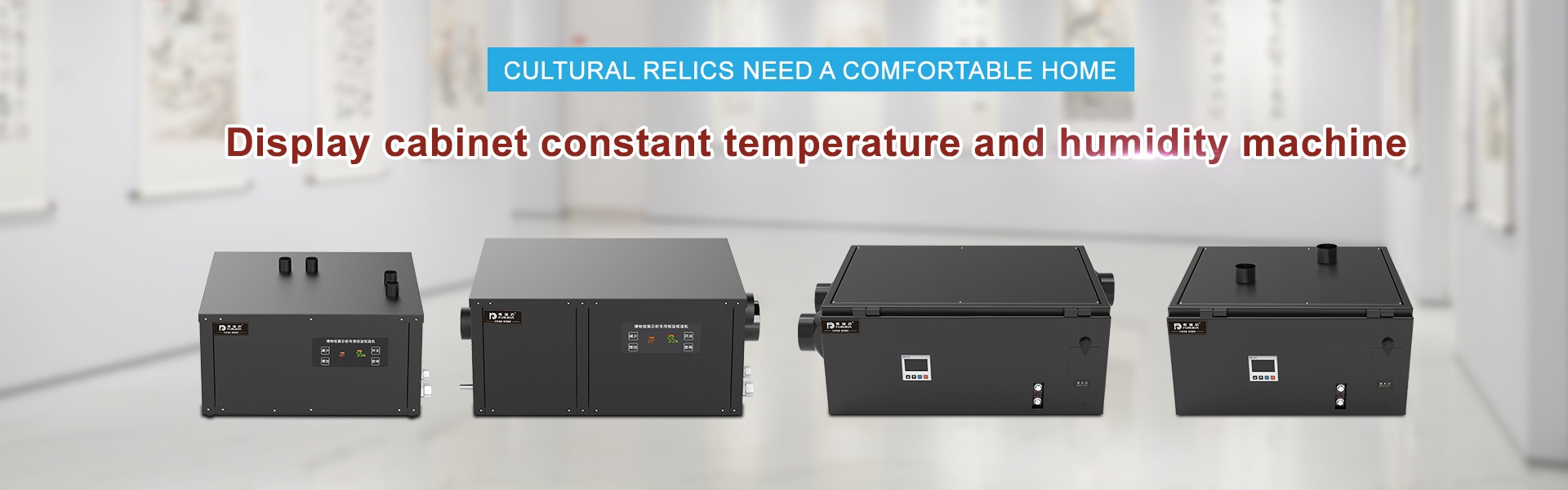

In the field of cultural heritage conservation, constant temperature and humidity units have become essential equipment for regulating the environment in exhibition halls and storage facilities. They maintain temperature and humidity fluctuations within a narrow range, thereby slowing the aging of organic artifacts and preventing salt efflorescence from damaging inorganic artifacts. However, during operation, this precision environmental control system may produce an easily overlooked side effect: low-frequency micro-vibrations. For artifacts that are extremely sensitive to mechanical disturbances—such as painted terracotta figurines, excavated lacquered wooden objects, and fragile mural fragments—these vibrations are not merely silent; they exert a continuous, latent stress on the artifacts’ structures.
The Hidden Dangers of Micro-Vibrations: Why Sensitive Artifacts Struggle to Withstand Them
The start-stop cycles of the compressor inside the constant temperature and humidity unit, the pulsating flow of refrigerant through the piping, the unbalanced rotation of fan impellers, and the air turbulence generated by air circulation all excite broadband mechanical vibrations during equipment operation. Among these, low-frequency components below 10 hertz decay slowly and possess strong penetrating power, making them highly likely to propagate through building structures into the artifact preservation areas.
For painted terracotta figurines, the clay bodies—having endured millennia of burial—have developed numerous microscopic cracks due to salt migration and freeze-thaw cycles. The bond between the painted layer and the clay body is already at a critical state. Continuous low-frequency vibrations act like repeated micro-impacts, potentially accelerating fatigue damage at the interface and ultimately leading to peeling and flaking of the paint.
Rational Layout: Reducing Vibration Input at the Source
The primary principle of vibration control is to spatially isolate the constant temperature and humidity units from sensitive cultural heritage areas during the planning phase. Ideally, the climate control unit should be housed in a dedicated equipment room that does not share floor slabs or load-bearing walls with exhibition halls or storage areas. When architectural constraints necessitate placement on the same floor, the equipment should be located far from areas with high concentrations of cultural artifacts, preferably in a corner or at the end of a corridor, to increase the distance over which vibrations must travel and leverage the building structure’s natural damping effects.
Vibration-Isolating Bases: Establishing the First Line of Defense
Even with spatial isolation, vibrations generated by the equipment itself will still transmit into the building through support points. The core function of vibration-isolating bases is to insert a highly flexible elastic layer between the equipment and the floor slab, allowing vibration energy to be absorbed and attenuated during transmission.
The design of vibration-isolating bases must adhere to the “mass-stiffness” matching principle. The base itself should possess sufficient inertial mass—typically achieved through cast-in-place reinforced concrete or a steel frame filled with ballast blocks—to lower the system’s center of gravity and suppress sway modes generated during equipment operation. Simultaneously, the total stiffness of the vibration isolation elements must be calculated based on the excitation frequency corresponding to the equipment’s operating speed, ensuring that the operating frequency of the isolation system is significantly higher than the natural frequency of the isolators themselves (typically requiring a frequency ratio greater than 3) to achieve effective vibration attenuation.
During installation, any rigid contact points between the base and the floor slab must be avoided. If anchor bolts penetrate the vibration isolation layer directly to anchor into the floor slab, the vibration isolation effect will be completely lost. All piping and cabling must be provided with flexible bends or sufficient suspension clearance to prevent rigid connections from forming vibration bridges.
Flexible Duct Connections: Cutting Off Secondary Transmission Pathways
Constant temperature and humidity units are typically connected to terminal equipment in exhibition halls or storage areas—such as fan coil units, air diffusers, and radiant cooling panels—via ductwork and supply/return piping. Even if the main unit is properly isolated from vibrations, vibration waves can still travel along the piping—especially through rigid connections between ductwork and copper tubing—and reach the areas housing cultural artifacts. This is known as “structural sound transmission” or “vibration transmission along the path,” and its harmful effects are often more insidious than those caused by direct vibration transmission from the unit itself.
The key to resolving this issue lies in installing flexible connectors at critical junctions. For duct systems, canvas or rubber fabric flexible connectors should be installed at the unit’s supply and return air interfaces; these should be at least 200 millimeters in length, and must maintain airtightness even when the unit experiences maximum vibration displacement. The flexible joint material should be a composite fabric that is resistant to aging and has low air permeability to prevent fiber shedding that could create new contaminants. For refrigerant or cooling water lines, stainless steel corrugated hoses or metal hoses should be installed near the unit side without affecting fluid flow. Corrugated hoses have multi-degree-of-freedom compensation capabilities and can absorb displacements caused by equipment vibration and thermal expansion and contraction.
The Path to Balance: Technical Choices That Do Not Sacrifice Temperature and Humidity Stability
Vibration-damping design should not come at the expense of compromising the control accuracy of constant temperature and humidity units. Excessively flexible bases or overly long flexible connectors may cause excessive displacement during equipment startup or shutdown, thereby affecting the alignment accuracy of fans and compressors and, in turn, inducing even greater vibration. Therefore, engineering design requires finding a delicate balance.
A viable strategy is to combine active and passive vibration isolation. Passive isolation (springs, rubber pads, etc.) isolates mid-to-high-frequency vibrations generated during steady-state operation; active vibration isolation systems, on the other hand, use sensors to monitor vibration signals in real time and generate counteracting forces via actuators to specifically cancel out low-frequency resonance peaks. Active vibration isolation is already well-established in the field of laboratory precision instruments and has gradually been introduced into cultural heritage conservation environments in recent years, proving particularly suitable for storage facilities housing fragile, vibration-sensitive excavated artifacts.
Conclusion
Constant temperature and humidity units are essential tools for modern museum environmental control, but their implementation should not come at the expense of the mechanical safety of cultural artifacts. Although micro-vibrations are small, their cumulative effect over time is sufficient to cause irreversible damage to fragile cultural artifacts. From rational layout to the meticulous design of vibration-damping bases, from flexible piping connections to the optimization of operating strategies, every technical aspect requires interdisciplinary professional collaboration. Only by integrating vibration control into the holistic engineering approach to cultural heritage preservation can a true balance be achieved between stable temperature and humidity and structural safety, allowing millennia-old artifacts to continue their existence in tranquility.
 vivienhu0427@hotmail.com
 +86 15958041362
 vivien@hzfreeair.com